
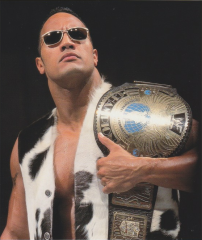
‘The Brahma Bull’ in the prime of his career, before things went downhill for many of ‘the millions’.
Before this article begins, let me just state that on a personal note, it was difficult enough for me to even consider writing this article, let alone actually writing it. Like many, I am an avid Rock fan, and he was, and to some extent still is, a hero of mine. But as I feel passionate about the demise of his once-beloved persona, I felt that writing this article was the right thing to do.
With his unmatched swagger, dominating persona, superior athleticism and countless catchphrases, Dwayne ‘The Rock’ Johnson is a man who heavily contributed to revolutionising the world of professional wrestling during the ‘Attitude era’. Debuting in the late 90s, the third-generation Superstar quickly made a name for himself in the WWE (WWF at the time), and was very much adored even when playing the role of a ‘heel’ (bad guy). It was extremely hard not to like ‘The Great One’, but it became significantly easier towards the end of his full-time wrestling career – when Hollywood came knocking on the door.
When The Rock returned from shooting ‘The Mummy Returns’ in 2001, things didn’t change much. Whilst looking physically leaner, his overall character remained, which was great to see. He was still brash, cocky, funny, and overall a larger-than-life stud. It seemed a taste of Hollywood didn’t change him too much. The big change however, came around the time of challenging Hollywood Hulk Hogan at WrestleMania X8. Our beloved Rocky changed – the bass in his voice lowered, he spoke more quickly and abruptly, lost the $500 shirts and $1000 rolexes, cut his hair, and started to lose his wrestling shape. His catchphrases sounded less meaningful, and more like mantras. It felt as if he had to get ‘get them out of the way’, so to speak.
Now right off the bat, these factors may sound somewhat silly and irrelevant to the casual fan. But those who knew The Rock’s career in the 90s immediately noticed the significant change. He was less of a badass, and inadvertently brought a bit of his early Hollywood career with him. Just look at Chris Jericho’s WWE debut, and then compare The Rock in this segment with him in his ‘Great Balls of Fire’ promo. The contrast is stark, and these are just two segments out of hundreds that can be compared.
Several departures and returns later, he, for the second time running, smartly used the fans’ gradual dislike towards him to his own advantage by creating a new Hollywood heel persona in 2003.

Out-of-shape and under a new ‘Hollywood’ persona, The Rock wrestles Austin in their third and final WrestleMania clash.
While this character wasn’t your usual Rock, it was actually quite refreshing and helped revamp his previously dying persona. It was an entertaining gimmick which made for a great heel, but unfortunately did not last long when he left once again after losing to Bill Goldberg at Backlash. The Rock gradually turned face again by returning several times in non-wrestling roles. He then returned once more to team with Mick Foley – reuniting ‘The Rock ‘n’ Sock Connection’ – and feuded with Evolution.
Face Rock was back, but in the eyes of many he still wasn’t all quite there. A large chunk of what we loved about him was missing. The Rock appeared four more times after this in minor roles, but then did not appear again until 2011 (excluding a couple of satellite vignettes and the 2008 Hall of Fame induction speech of his father, Rocky Johnson, and grandfather, Peter Maivia).

The Rock’s 2011 return
In 2011, The Rock made a triumphant return as the special guest host of WrestleMania XXVII. Everyone was eager to see their childhood hero make a comeback, but to many the excitement was short-lived. Rocky looked great, he was back in shape, wore an ‘I BRING IT’ tank-top, and completely shaved off all his hair. He even rocked (pardon the pun) a pair of sunglasses. It was amazing to hear him utter the words ‘FINALLY, THE ROCK, HAS COME BACK…HOME…’. His first return promo was generally awesome, but the hardcore fans already began to notice the cracks in his persona.
Any avid wrestling fan knows that The Rock always speaks in third-person, but the constant use of ‘I’ really diminished the effect of the promo. Every ‘I’ spoken felt like a small stab to the Rocky fans who tuned-in. It just wasn’t natural. He also said something along the lines of “Let me take a moment as Dwayne…”, and gave a personal mini-speech explaining how glad he was to be back. While it’s understandable as to why he did this, this again tarnished his return. He’s a great and inspiring individual, but as wrestling fans, we only want The Rock. If we wanted Dwayne, we’d watch his movies and interviews. You don’t see The Undertaker returning and saying “Let me take a moment as Mark Calaway…”! However, overall, the promo was brilliant and the constant digs at John Cena really made everyone erupt.
The Rock and John Cena went back and forth, verbally, physically, and even remotely (well, in Rocky’s case). The insults from both ends were priceless, and were sprinkled from WrestleMania XXVII all the way through to the next two WrestleManias. However, further down the line, it almost felt as if Rock became everything he despised about Cena – a Captain America-like hero.
The majority of hardcore wrestling fans (who, for obvious reasons, were on ‘Team Bring It’) seemed to be in denial about being more entertained by Cena’s content, and the momentum gradually shifted from ‘The Brahma Bull’ to Mr ‘Fruity Pebbles’. The Rock began to tell stories of his past relating to every town/city that RAW/SmackDown was in, which, although entertaining at some points, grew very boring and uninteresting. Notes on Rocky’s wrist were even spotted during a promo, which was called-out by the ‘Dr of Thuganomics’ himself. ‘Story-time with The Rock’ was no longer cool.

The Rock cuts a shaky promo on CM Punk
Throughout his two-to-three year return, ‘The Great One’ feuded with several other Superstars (including CM Punk), which led to more promo segments. Unlike the past, the ‘millions’ often feared for Rocky during his verbal bout with the current ‘jabroni’ he squared-off with. Being on the receiving end of a verbal dig, stuttering upon his own words, or repeating the same lines over and over again, became a common occurrence for The Rock. It was actually nerve-racking to watch him cut promos – they most definitely were not as organic or as fluid as they used to be.
From all that’s been said, it should be noted that the current ‘PG era’ definitely played a part of The Rock’s watered-down content during his return. But even with this in mind, there was a factor of brilliance that was sincerely missed after Hollywood came calling. In terms of in-ring ability, Rock certainly hadn’t lost it (although his second bout with Cena had one of the laziest and most unimaginative climaxes to a main event that pro wrestling has ever witnessed). There were signs of rustiness, but overall he maintained if not improved his smooth in-ring work.
Having said all this, there is no doubt that Dwayne ‘The Rock’ Johnson has continued to inspire and achieve greatness. His charisma, drive, and passion has paved the way for WWE Superstars and people alike, and despite knowing that we’ll never get ‘Attitude era’ Rock again, he’ll forever remain our ‘People’s Champion’.
What do you think? Do you agree that Rocky’s character has become stale, or do you like the evolution that his persona has taken? Leave a comment!
Please note that these images are each owned by their respective owners, I do not own any of them. No copyright infringement is intended.
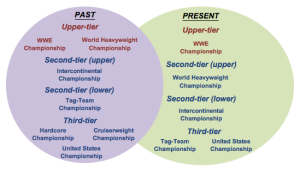
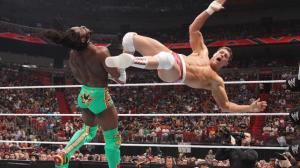 It’s tough to define the term ‘mid-carder’ in the modern world of professional wrestling. Historically, mid-carders are second-tier performers who wrestle in the middle of programmes, usually competing for the secondary title of the company. Mid-carders often tend to eventually secure a spot in the top-flight division, and end up creating a legacy of their own that cements itself in the history of the business.
 Canvas to Canvas